
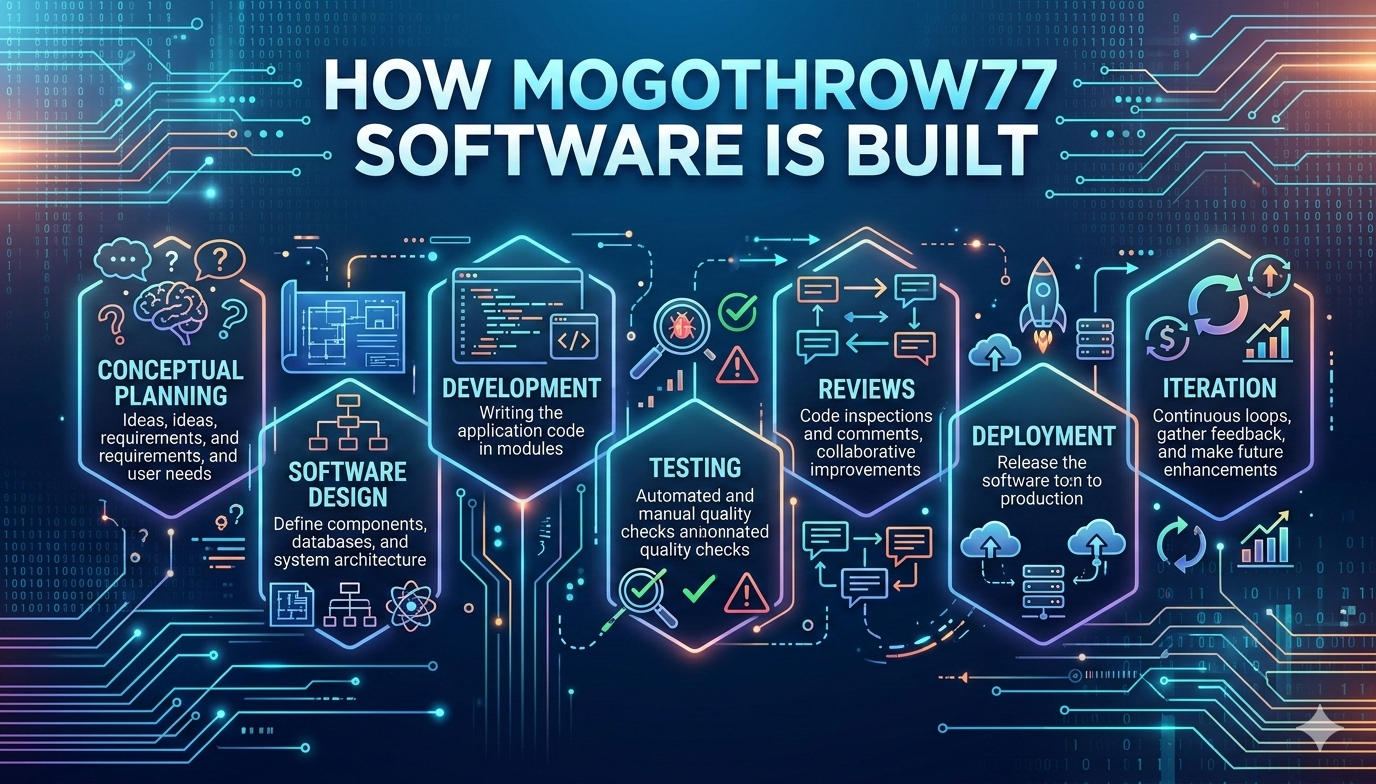
The development of modern digital platforms requires structured planning, coding expertise, and scalable infrastructure. In this article, we explore in detail how mogothrow77 software is built from concept to deployment. The system combines programming logic, database management, security layers, and performance optimization to deliver reliable functionality.
This framework is designed to meet enterprise standards while maintaining flexibility for future upgrades. Developers follow structured development phases to ensure stability and efficiency when creating advanced applications.
Core Development Philosophy
The foundation of the system is built on clear coding principles and modular design. Understanding how mogothrow77 software is built helps developers break complex tasks into manageable components.
The project begins with requirement analysis, system modeling, and architecture planning. Teams define user needs, performance expectations, and security requirements before writing any code. Agile methodologies guide development cycles to ensure continuous improvement and testing. feedworldtech, bouncemediagroup, severedbytes, roarleveraging, pblinuxtech, shotscribus, pblemulator, gfxpixelment
Development Architecture
The architecture defines how different modules communicate and operate together. Backend services handle data processing while frontend interfaces manage user interaction. Knowing how mogothrow77 software is built allows developers to design scalable APIs and efficient request handling systems.
Microservices or modular architecture patterns are often used to separate business logic from interface logic. This separation improves maintainability and reduces system downtime during updates. Cloud-based infrastructure supports distributed processing and high availability.
Technology Stack
Technology selection plays a major role in system performance. The technology stack determines how fast, secure, and scalable the platform becomes. Engineers analyze performance benchmarks before finalizing tools.
Developers document every stage to understand how mogothrow77 software is built using programming languages, frameworks, and database engines. Backend languages process server-side logic while frontend frameworks create interactive user experiences. Databases store structured and unstructured data efficiently. endbugflow, Feed by way, connecting to wifi, viral manners, networth.
Cloud hosting providers manage computing resources and storage capacity. Containerization tools enhance portability and simplify deployment across different environments.
Security Implementation
Security is integrated from the early development stage. Authentication systems, encrypted communication, and access control policies protect sensitive information.
Security engineers analyze vulnerabilities and strengthen system defenses. Understanding how mogothrow77 software is built reveals that encryption protocols and secure API endpoints play a critical role in preventing unauthorized access.
Regular security audits and penetration testing help identify risks. Firewalls, token-based authentication, and role-based access control add multiple protection layers. what is mogothrow77 software informer
Testing and Quality Assurance
Testing ensures reliability before release. Automated test scripts validate core functionality and detect errors in real-time. Manual testing verifies user experience and interface responsiveness.
Quality assurance teams carefully review product performance to confirm that how mogothrow77 software is built meets technical standards. Stress testing evaluates system behavior under heavy traffic conditions. Bug tracking systems record and manage reported issues for resolution.
Continuous integration pipelines automatically test code changes before deployment. This approach reduces development errors and improves stability.
Deployment Strategy
Deployment transforms development code into a live application. Engineers configure servers, set environment variables, and optimize database connections before launch.
Cloud platforms simplify deployment through automated scaling and monitoring features. Professionals study how mogothrow77 software is built to ensure smooth transitions from testing environments to production servers.
Rollback mechanisms are prepared in case updates cause unexpected issues. Monitoring tools track performance metrics and alert administrators about system irregularities.
Performance Optimization
System speed and responsiveness depend on optimized code and resource management. Developers reduce unnecessary queries and compress data transfers to improve loading times.
Caching systems store frequently accessed information to reduce server load. By analyzing how mogothrow77 software is built, engineers identify bottlenecks and enhance processing efficiency.
Load balancing distributes traffic across multiple servers. This prevents system crashes during high usage periods. Regular performance audits maintain long-term stability.
Maintenance and Updates
After deployment, continuous maintenance keeps the platform secure and functional. Developers release patches, feature upgrades, and bug fixes based on user feedback.
Maintenance teams closely monitor system behavior to understand how mogothrow77 software is built in practical environments. Logs and analytics tools provide insights into usage patterns and technical issues. cwbiancavoyage, decoratoradvice, programgeeks, Stonecap3.0.34 Software, magazinoor
Database optimization and dependency updates improve system longevity. Scheduled maintenance windows allow safe implementation of improvements without disrupting users.
Future Enhancements
Technology evolves rapidly, and software must adapt accordingly. Future development may include artificial intelligence integration, automation features, and improved data analytics.
Innovation teams continuously evaluate improvements to strengthen functionality. Studying how mogothrow77 software is built helps developers expand features without affecting existing performance.
Scalable design ensures that new modules integrate seamlessly into the platform. Expansion into new regions such as the United States markets increases global reach and accessibility.
Challenges and Solutions
Every development project faces technical and operational challenges. Common issues include compatibility errors, security vulnerabilities, and system latency.
Teams analyze these challenges by reviewing system architecture and performance metrics. Understanding how mogothrow77 software is built enables developers to identify weak points and apply corrective strategies.
Collaboration between developers, testers, and system administrators improves problem-solving efficiency. Continuous improvement practices reduce long-term risks.
Conclusion
In summary, the success of digital platforms depends on structured planning, secure coding, and efficient deployment strategies. Throughout this article, we explored technical components and development stages in detail.
From architecture design to security implementation, professionals carefully manage each phase to ensure stability. Repeated analysis of how mogothrow77 software is built demonstrates that scalability, security, and performance remain key priorities.
By following best practices and maintaining continuous improvements, the system can evolve with technological advancements while serving users effectively.













Leave a Reply