
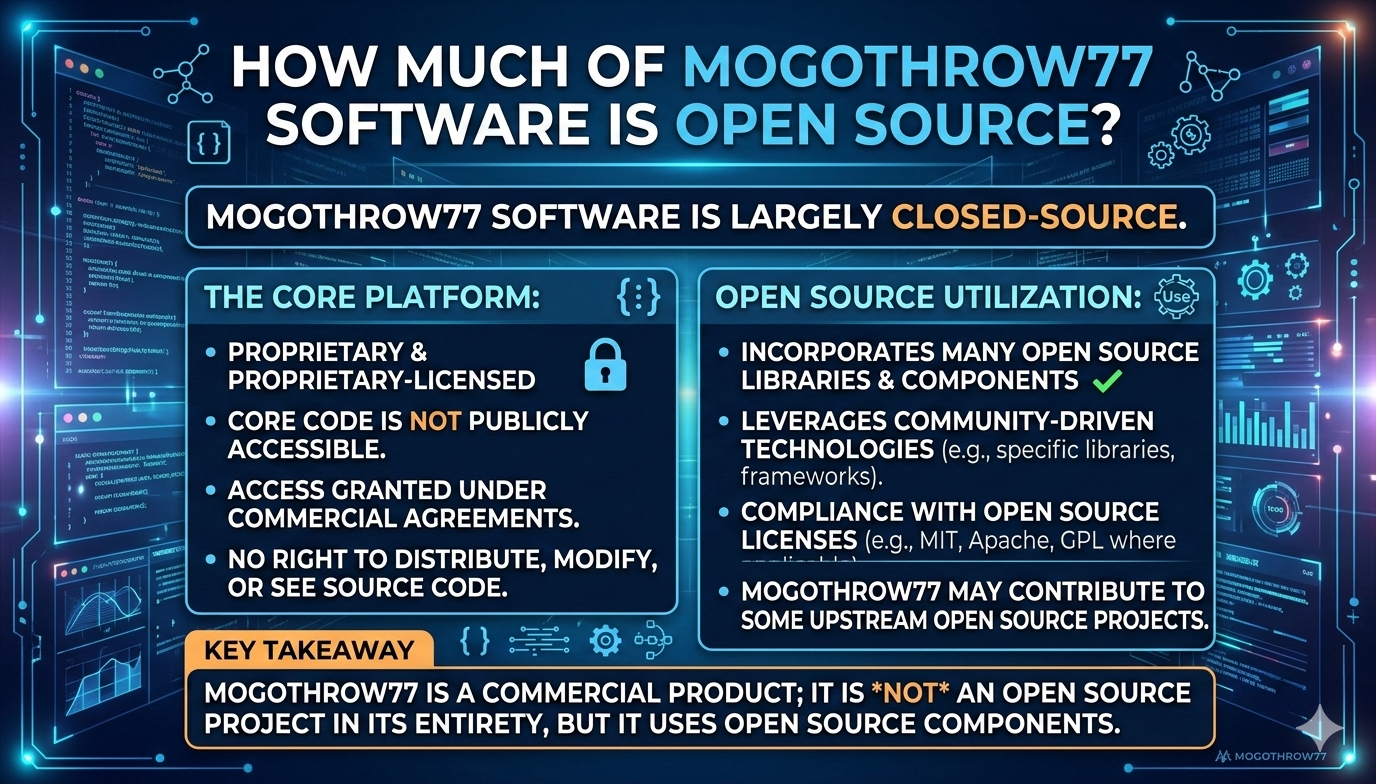
The discussion around transparency, licensing, and accessibility plays a major role in understanding modern software ecosystems. In many technical communities, users frequently ask about ownership rights, modification permissions, and redistribution freedom. The phrase how much mogothrow77 software is open source often appears when developers and businesses evaluate whether the platform allows public inspection of its source code. Evaluating these aspects requires examining documentation, repository availability, and licensing terms in detail.
Mogothrow77 software has gained attention because organizations want clarity about development control and collaborative potential. When stakeholders analyze its structure, they typically review whether components are publicly accessible or restricted to internal teams. Understanding how development is managed helps determine scalability and integration possibilities. Many technical analysts evaluate code visibility, contributor access, and documentation quality to answer questions related to openness. The interest in transparency grows as digital transformation expands globally.
Licensing Model
Licensing determines how software can be used, modified, and shared. In legal frameworks across multiple regions, including businesses operating in the United States, license agreements define user permissions. Companies often review contractual conditions before implementing software at scale. Discussions frequently include the term how much mogothrow77 software is open source when comparing licensing restrictions.
Organizations assess whether redistribution is allowed and whether modifications require approval. If a license grants broad rights, developers gain flexibility to adapt features according to project needs. On the other hand, restrictive licenses may limit commercial usage. Legal clarity ensures compliance and reduces risk for enterprises that depend on technology infrastructure.
Understanding license documentation involves reading permission clauses carefully. Technical teams usually analyze intellectual property ownership, attribution requirements, and warranty disclaimers. Transparent licensing improves trust and encourages collaboration across development communities.
Open Source Components
Software systems today often combine proprietary modules with open frameworks. Developers examine repositories to determine which sections are publicly available. When reviewing architecture, analysts sometimes ask how much mogothrow77 software is open source to identify which components can be inspected.
Open source components typically include libraries, user interface frameworks, and shared utilities. These elements allow programmers to contribute improvements or fix bugs. Public repositories enable code review and peer feedback, strengthening overall reliability.
Many development teams encourage community participation because external contributors improve performance and security. Documentation and version control platforms play a critical role in maintaining transparency. By separating core proprietary algorithms from publicly shared modules, companies create hybrid systems that balance control and openness.
Code Accessibility
Code accessibility refers to whether developers can view and modify source files. Accessibility affects innovation because open inspection allows debugging and enhancement by independent programmers. The question how much mogothrow77 software is open source becomes relevant when evaluating repository access.
If repositories are hosted on public platforms, developers can track commits and updates. Change logs provide insight into feature improvements and security patches. Transparent update cycles strengthen credibility among technical users.
Access control mechanisms may restrict sensitive modules while permitting access to foundational tools. Such segmentation ensures sensitive business logic remains protected while still promoting collaboration on general utilities. how is mogothrow77 software installation
Community Contribution
Community involvement significantly improves software quality. Active forums, discussion boards, and contribution guidelines allow programmers to report issues and propose improvements. Many contributors ask how much mogothrow77 software is open source before investing time in development.
Open contribution systems often require pull requests, code reviews, and testing protocols. These procedures maintain consistency and prevent errors from entering stable releases. When developers collaborate effectively, innovation accelerates.
Communities operating across international markets, including organizations in the United States, often participate in open development models. Shared knowledge strengthens platform growth and builds trust among stakeholders. Contributor recognition programs further motivate participation.
Transparency in United States Market
Businesses operating in the United States follow strict compliance standards regarding data protection and intellectual property. Technology companies often evaluate transparency before integrating third-party platforms. Stakeholders frequently research how much mogothrow77 software is open source to determine legal and operational compatibility.
Transparency helps enterprises assess security vulnerabilities and audit system behavior. Public documentation allows independent security experts to review code quality. This practice reduces dependency on vendor-controlled secrecy.
Companies that operate globally benefit from transparent development policies because international clients demand accountability. Clear communication about feature updates and licensing conditions strengthens professional relationships. When transparency improves, adoption rates often increase across diverse industries.
how much mogothrow77 software is open source plays an important role in determining whether collaboration with global partners becomes feasible. Open visibility enhances trust and reduces uncertainty during enterprise integration.
Comparison With Closed Source
Closed source software restricts code visibility and limits modification rights. Organizations using closed systems rely on vendor support for updates and security patches. In contrast, open systems encourage independent verification.
When comparing models, analysts often evaluate how much mogothrow77 software is open source to determine flexibility levels. Open structures allow developers to customize functionality according to project requirements. Closed systems may provide stability but reduce adaptability.
Security debates frequently arise around these models. Some experts argue that open inspection improves vulnerability detection because more reviewers examine the code. Others claim controlled environments reduce unauthorized alterations.
Decision-makers assess business objectives before selecting deployment models. Budget considerations, technical expertise, and long-term scalability influence technology selection strategies.
Benefits and Limitations
Every software ecosystem contains strengths and limitations. Open access improves collaboration but may expose internal logic. The question how much mogothrow77 software is open source highlights this balance between transparency and protection.
Benefits include community support, innovation acceleration, and reduced development costs. Developers can reuse code modules instead of building from scratch. Shared libraries decrease duplication and improve efficiency.
Limitations involve governance challenges and coordination complexity. Managing contributions from multiple developers requires strong oversight. Documentation must remain updated to prevent confusion.
Organizations operating in competitive markets analyze these advantages carefully. Strategic planning ensures that open elements align with business objectives while safeguarding proprietary advantages.
Future Development
Future expansion depends on architectural decisions and community engagement. Roadmaps typically outline upcoming features, performance upgrades, and security enhancements. Stakeholders often evaluate development trends by examining how much mogothrow77 software is open source.
If development teams increase public repository visibility, participation may grow significantly. Transparent planning encourages external developers to contribute innovative solutions. Continuous integration systems help maintain quality standards.
Technological advancements such as artificial intelligence integration, automation tools, and cloud scalability may shape future releases. Open frameworks allow experimentation with emerging technologies. Adaptability remains essential for sustainable growth.
Long-term success requires balancing innovation with stability. Effective governance ensures that open collaboration remains structured and productive.
Final Thoughts
Understanding software transparency requires detailed examination of licensing, community engagement, and technical accessibility. The concept how much mogothrow77 software is open source continues to guide discussions among developers, businesses, and analysts.
Clear documentation strengthens trust and promotes responsible development practices. Organizations across international regions, including operations connected to the United States, benefit from transparent policies. Open collaboration fosters innovation while maintaining structured oversight.
As technology evolves, evaluating openness remains an ongoing process. Stakeholders must continuously review updates, licensing adjustments, and repository changes. Sustained transparency supports growth and ensures alignment with modern software standards.
how much mogothrow77 software is open source remains a central question for decision-makers exploring integration opportunities and long-term investment strategies. Continuous assessment guarantees informed choices and strategic technological advancement.










Leave a Reply